INDEX / BLOG
Survival is Not Stability
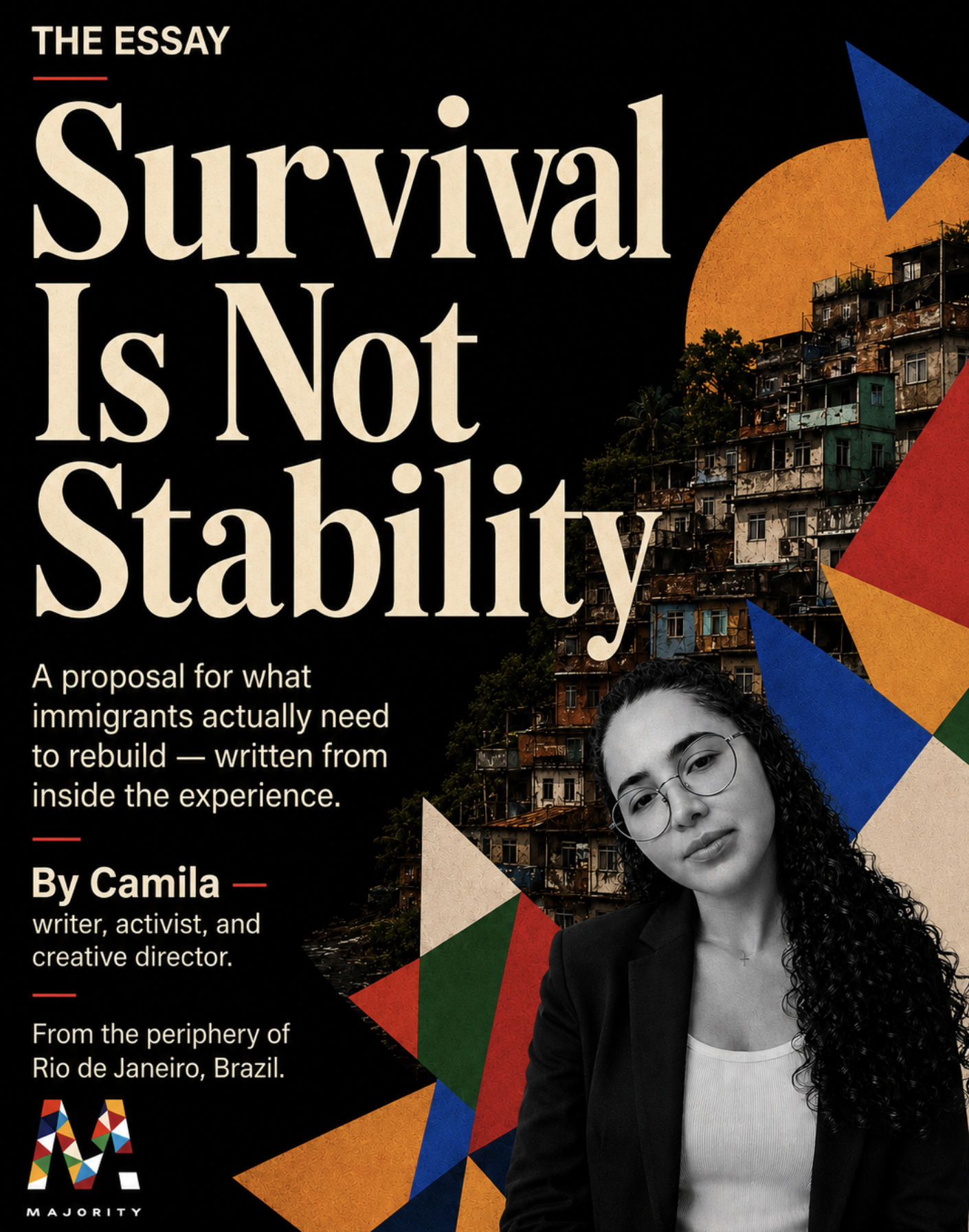
The Winner of Our Blue Zebra Social Action Writing Contest is Camila Cre Dio
Camila is a Brazilian immigrant, writer, photographer, and creative director based in San Diego. She arrived in the United States without speaking English, without financial stability, and without a roadmap — and has been building one ever since. This essay is written from inside that experience.
Survival Is Not Stability
A proposal for what immigrants actually need to rebuild
I arrived already depleted — by a country that had little left to offer, by a family that could not hold itself together, by years of insecurity that had no single name but lived in the body like a low, permanent hum. I left Brazil not toward something, but away from a slow erosion I could no longer sustain.
What I found on the other side was not clarity. It was a different kind of disorientation. I had a whole language inside me. My mother tongue. An entire world of words, feelings, and ways of knowing. But English had not yet grown a body. I could memorize the word grief, but I could not feel it in English. The language existed first as code, and only later — slowly, over years — as experience. In between, there was a silence that no class, no pamphlet, no well-meaning stranger could fill.
I learned to adapt. But adaptation, I came to understand, is not always expansion. Sometimes it is contraction. You learn the size of the river, and you become the kind of shore that fits.
This is not only my story. It is what happens when a person arrives before the system has any category for what they are carrying — and what they need to begin again.
The problem no form asks about
When we talk about immigration, we usually talk about documents, jobs, housing, and language classes. These things matter. But they are not sufficient. Underneath them is something harder to name and harder to fix: the loss of orientation.
Orientation is not the same as information. You can hand someone a pamphlet and still leave them completely lost. Orientation is knowing how things work — not just where the office is, but what to say when you get there, what your rights are, whether it is safe to ask, and what will happen if you
do. It is the quiet confidence of someone who has context. And it is one of the first things migration takes away.
For many immigrants — especially those who arrive without money, without English, and without a stable network — this loss does not arrive alone. It arrives stacked on top of whatever they were already carrying. Poverty. Family rupture. Violence. Years of surviving in places that were also failing them. They do not arrive as blank slates ready to build. They arrive already tired, already contracted, already shaped by absence.
The current system does not see this. It sees a case. It sees a need for housing, for a job, for English. It offers help — when it offers anything at all — in 90-day windows, in waiting rooms, in forms written for people who already understand the bureaucracy they are trying to enter.
And then it calls the result self-sufficiency.
When reconstruction fails, the cost does not disappear. It shifts — into unstable labor, unsafe housing, preventable health crises, communities that never quite hold together. The system pays eventually. It just pays later, and less humanely.
I think of a young woman I met once, traveling from the northeast of Brazil. She was tired — I could see it in her eyes. Tired of years of violence, of a husband she had finally found the courage to leave. She had borrowed money for the ticket. She was carrying her three-year-old son. She was going to try to cross without documents, because she had run out of options that felt safer. At the airport, officials asked her for money to let her through. I watched it happen. She paid what she could. I don’t know where she went after that. I don’t know what her son remembers. But I think about them — because they are not an exception. They are what happens when a person has nowhere safe to go, and the systems that should protect her are the ones asking for payment.
The consequences are not abstract. Without orientation, people stay in jobs that exploit them because they do not know they have options. They avoid healthcare because the system feels too foreign to navigate alone. Their mental health deteriorates quietly, without anyone to notice or intervene. Their children grow up watching a parent disappear into survival — and absorb the lesson
that this is simply what life looks like. And people who could contribute enormously — to their communities, to the economy, to the fabric of this country — spend years, sometimes decades, trapped in a cycle they never had the conditions to break.
Regardless of legal status, people arrive. That is a fact. And when they do — documented or not — the absence of orientation creates the same cycle: exploitation, poor decisions, deteriorating health, children absorbing instability as normal. A system serious about social stability cannot afford to ignore this reality.
When the door exists but you don’t know where it is
There are programs. Organizations, phone numbers, intake forms. But to access help, you first need to know it exists. You need to know you qualify. You need enough language to ask, and enough trust to believe that asking will not cost you something you cannot afford to lose.
Most newly arrived immigrants have none of those things — not because they are incapable, but because they are new, afraid, and already carrying more than anyone should carry alone. Honestly? For a long time, it never even crossed my mind that help might exist. I was too busy trying to survive to go looking for something I didn’t know was there.
The door is open. But you do not know where the door is. And nobody comes to find you.
This is not a personal failure. It is a design failure. A system that requires fluency and confidence from the people least likely to have them is not really built to support. It is a filter — one that reaches those who were already closer to stable, and misses those who needed it most.
When you are that disoriented — financially unstable, linguistically limited, socially isolated — your ability to make clear decisions shrinks. Not because you are weak. Because the conditions make clarity almost impossible. What looks like a bad choice from the outside is often the only visible option from the inside. You take the first job offered, even if it traps you. You stay in unsafe housing because you do not know you have a right to leave. You trust the wrong people because
they speak your language and that, in a foreign country, can feel like safety. Not because you are naive — but because you are alone.
Familiarity is not the same as safety
When formal support is missing or invisible, immigrants often turn to their own communities. This is instinctive — and at times, the only thing that prevents complete isolation. Shared language, shared culture, shared reference — these things offer relief that no government program can replicate. There is something in being understood without having to translate yourself that restores a little of what migration took.
But community without structure can also be fragile. When everyone around you is also struggling, also afraid, also operating with too little — the same network that offers comfort can also reproduce instability. Information gets distorted. Dependencies form. People with slightly more power use it, sometimes without even realizing it.
Cultural familiarity can feel like safety, especially when everything else is foreign. But familiarity alone does not create protection. It does not mediate conflict. It does not hold anyone accountable. And when resources are scarce, even the most well-meaning communities can fracture under the pressure.
This is not about blaming communities for what systems refuse to provide. It is about being honest: people under pressure need more than goodwill. They need structure — not because they cannot be trusted, but because structure is what allows trust to form safely, and what prevents the most vulnerable from paying the highest cost.
What rebuilding actually requires

Photo Source: camila (@camilanewreality)
Paulo Freire, a Brazilian philosopher of liberation, wrote that to take away someone’s ability to make their own decisions is to turn them into an object. Most immigrant support systems — when they
exist — do exactly this. They process people. They move cases. They measure success by whether someone found a job in 90 days, not by whether that person can plan for next year, trust their own judgment, or feel that they belong somewhere.
Survival and reconstruction are not the same thing. Survival keeps someone alive. Reconstruction gives someone back the conditions to become themselves again — to plan, to connect, to contribute, to feel that they are somewhere rather than just passing through.
None of this is complicated in theory. But it requires time, and it requires design.
It requires housing that is stable long enough to matter — not a 30-day shelter, but a place where you can sleep without fear and wake up knowing you will still be there tomorrow.
It requires language support tied to real life — not only grammar and vocabulary, but the English of a doctor’s appointment, a lease, a workplace disagreement, a conversation where you need to advocate for yourself.
And just as important — it requires someone who knows the system and walks with you through it. Not a document, but a person. Someone who was once where you are and came through it.
Someone who can say: this is what that form means, this is who to call, this is what you are allowed to ask for.
It requires time that is protected — space between arrival and the demand for full independence, where a person can breathe long enough to begin to think clearly again.
It requires the possibility of contribution — because people do not rebuild by only receiving. They rebuild when they can also give, teach, mentor, participate. The moment someone stops being only a recipient and becomes a person with something to offer is often the first real sign that reconstruction has begun.
A practical model: Community-Based Immigrant Stabilization Homes
What I am proposing is not new infrastructure built from nothing. It is a structured model that brings together things that already exist — housing, language support, peer mentorship, case navigation, and community — and holds them together long enough to actually work.
Community-Based Immigrant Stabilization Homes are transitional residences designed for newly arrived immigrants in vulnerable transition. Not emergency shelters. Not permanent housing. A bridge — 12 to 18 months — between arriving and being ready to stand independently.
Each home would serve 8 to 12 residents and operate around six core elements:
Stable housing with medium-term security. Residents know they will not be asked to leave in 30 days. This alone changes what becomes possible to think. When survival is no longer the only question, other questions can finally be asked.
Real-life language support. Not only ESL classes, but English embedded in daily situations — how to talk to a landlord, how to describe symptoms to a doctor, how to ask for what you need without losing dignity. Language as access, not just communication.
Peer mentors who have lived it. Immigrants who are farther along in their own reconstruction, trained to guide newcomers through the systems they once did not understand. This transforms former recipients into contributors — and that transformation matters for both.
A case navigator. One person whose job is to know the landscape: legal aid, healthcare enrollment, employment pathways, benefits, schools. Not to do everything, but to make sure no one disappears into the gap between services.
Structure within the home. Weekly check-ins. Shared responsibilities. Conflict mediation. Communal meals. Small rituals of collective life that rebuild the sense that you are part of something, not just surviving alone inside it.
A pathway to permanence. Everything in the model is oriented toward the moment residents leave — with stable employment, a clear housing plan, a legal case underway, a network of real relationships, and enough English to navigate what comes next.
Making it real: pilot budget and execution
None of this requires invention. It requires decision.
A pilot program — one house, one city with high immigrant need — is achievable with existing partnerships.
Estimated annual budget for a 10-resident pilot:
| Item | Estimated Cost |
| Rent/lease | $48,000 – $72,000 |
| Utilities, internet, supplies | $12,000 |
| Program coordinator | $55,000 – $70,000 |
| Part-time case navigator | $25,000 – $35,000 |
| Transportation assistance | $6,000 |
| Language support and materials | $8,000 |
| Emergency resident fund | $10,000 |
| Administrative and insurance | $15,000 – $20,000 |
| Total | $179,000 – $233,000/year |
At first glance, this cost may seem excessive. It is not. It represents approximately $18,000 to
$23,000 per resident per year. Emergency shelter, crisis healthcare, and repeated displacement from dangerous living situations cost far more — and produce far less.
Funding would come from philanthropic grants, city and county immigrant inclusion funds, faith-based partners, nonprofit partnerships, and corporate community grants. Referrals would come from immigrant organizations, domestic violence programs, community clinics, churches, and legal aid groups.
Success would be measured not only by housing stability and employment — but by English progress, healthcare enrollment, legal case connection, and something harder to quantify but essential: whether residents report feeling that they can navigate the world and trust their own judgment again.
What we are really asking
A society that helps people survive but not rebuild is not offering inclusion. It is prolonging instability — and then wondering why nothing changes.
Immigrants do not need to be saved. They need conditions — time, stability, environments where the river is wide enough that they do not have to keep contracting to fit.
This is not charity. It is architecture — the kind that makes reconstruction possible instead of accidental. It treats belonging not as a feeling to be earned, but as infrastructure to be built. It treats language not as a skill to be checked off, but as the difference between a person who can advocate for herself and one who cannot.
Most of all, it treats the person who arrives depleted — not as a problem to be processed, but as someone whose capacity to contribute, to connect, and to grow is not gone. It is waiting for the right conditions.
The research exists. So do the models. What has been missing is the decision to treat reconstruction as something the system owes — not as a lucky outcome for those who managed to find their way despite it.
That changes when we stop mistaking survival for success — and begin designing for reconstruction.
References
Eva Hoffman, Lost in Translation (1989); Bessel van der Kolk, The Body Keeps the Score (2014); Paulo Freire, Pedagogy of the Oppressed (1968); Martha Nussbaum, Creating Capabilities (2011); Shawn Ginwright, “The Future of Healing” (2018); US Surgeon General, Our Epidemic of Loneliness and Isolation (2023); Sendhil Mullainathan & Eldar Shafir, Scarcity (2013).
Camila is an artist and a photographer. Follow her and support her: camila (@camilanewreality): https://www.instagram.com/camilanewreality/
The Majority Project looks forward to further developing this model with Camila to make it a reality. Learn More: www.iAmMajority.com